In a quiet suburban neighborhood, young Calvin, the ultimate chaos machine with his wild spiky yellow hair and mischievous grin, stood in the living room eyeing his father. His dad, a sensible man in a black sweater, stood with arms crossed as Calvin dramatically gestured toward the old television set.
“You know, before there was television, kids actually did things on nice days like this,” his dad said, trying to impart some wisdom.
Calvin, never one to miss a beat, shot back with a cheeky smile, “Times sure change, huh Dad?”
But when Calvin tried pushing the conversation into deeper, more uncomfortable territory — “Ever notice how Dad brings up subjects he doesn’t want to talk about?” — his father had enough. In one swift motion, the door flew open, and Calvin was gently but firmly escorted outside, tumbling onto the porch with a surprised expression.
Undeterred, Calvin ran straight to his best friend and partner-in-crime: Hobbes, the big, orange-striped tiger who only comes alive for him.
“Pull me way back!” Calvin demanded, gripping the swing tightly. Hobbes, with his usual mix of enthusiasm and slight concern, pulled the swing as far as his tiger strength would allow.
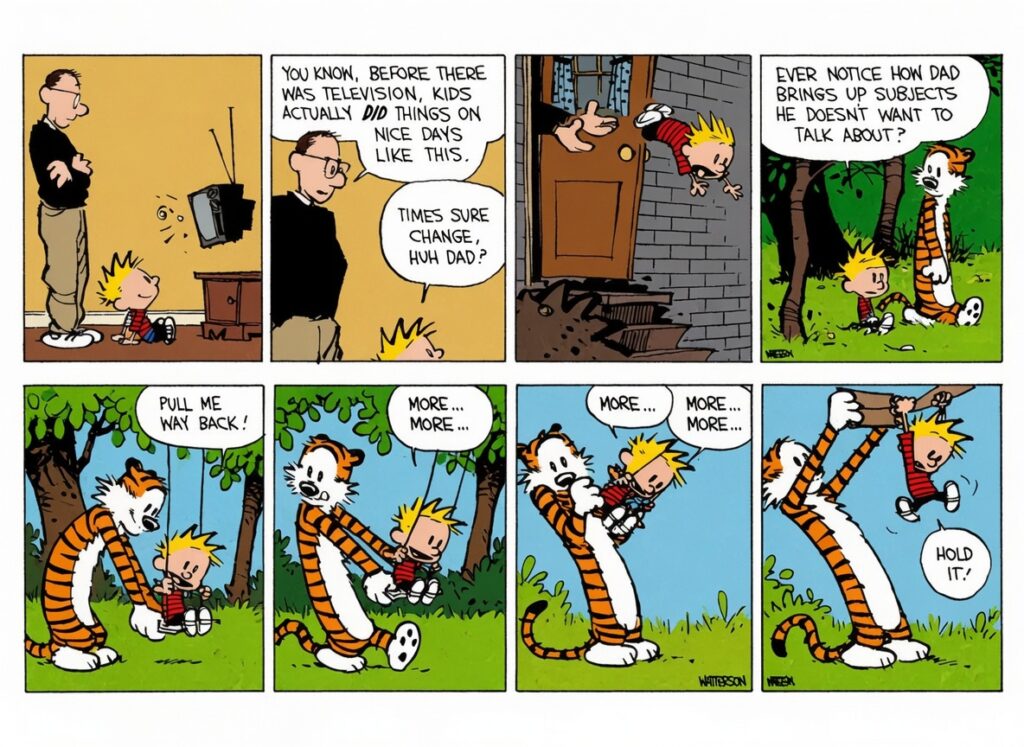
“More… more…” Calvin kept shouting, his voice full of pure joy and reckless abandon as he soared higher and higher into the blue sky.
In the final moments, as the swing reached its peak and gravity began to take over, Hobbes — now clearly worried — yelled, “Hold it!” while desperately trying to keep his wild friend from flying off into the trees.
This beloved Calvin and Hobbes strip perfectly captures the beautiful chaos of childhood: pushing boundaries, asking the questions adults don’t want to answer, and finding pure freedom in the simplest moments — even if it means risking a crash landing with your loyal tiger best friend by your side.