A Moment Frozen In Time
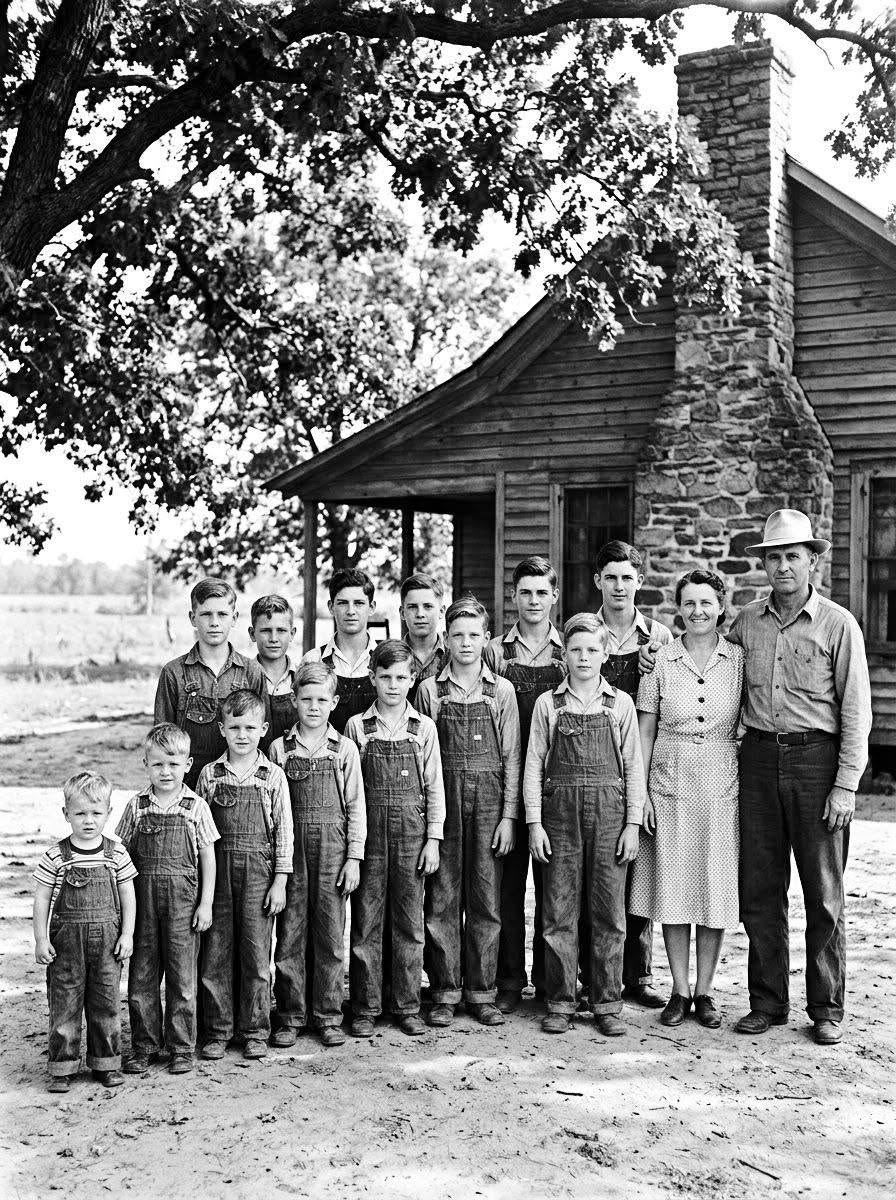
There are photographs that simply capture faces, places, and dates. Then there are photographs that seem to preserve an entire world that has slowly disappeared. An old family portrait from rural America in the 1950s may appear simple at first glance — parents standing proudly outside their home, children lined up beside them, everyone dressed in everyday clothing with serious expressions. There is no famous person, no historic event, and no dramatic scene unfolding. Yet somehow, the image holds a quiet power that reaches across generations.
The father standing at the center represents a familiar figure from mid-century America: a person shaped by responsibility, hard work, and the belief that family was something built every single day. His posture carries the confidence of someone who understands the weight of providing for others. He does not need a grand expression or a polished appearance to show his role. His presence alone tells a story of commitment, sacrifice, and perseverance.
Beside him stands the mother, whose gentle expression creates a sense of warmth and balance. In many families of that era, mothers were the heart of the household, managing countless responsibilities that often went unnoticed. They created routines, comforted children, kept families connected, and transformed a house into a home. Together, the parents represent a generation that believed love was not only something spoken — it was something demonstrated through daily actions.
The World Behind The Photograph
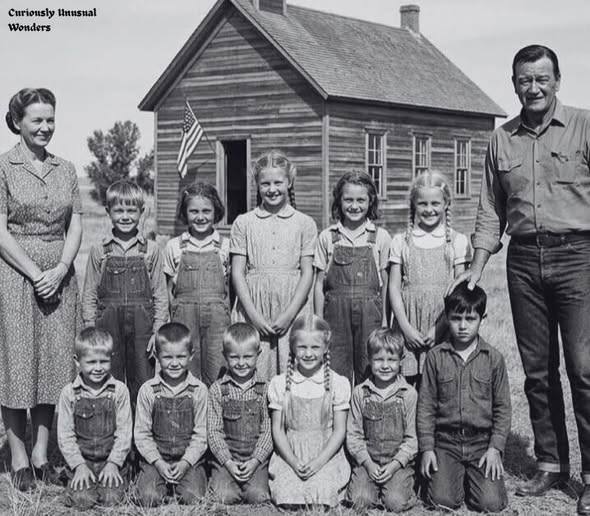
To truly understand photographs from the 1950s, it is important to remember the world that created them. Rural America during that period was built around a different rhythm of life. Many families depended on farming, local work, and close relationships with neighbors. Days were organized around the changing seasons, the needs of the land, and the responsibilities that came with maintaining a household.
There were no smartphones, no endless entertainment options, and no instant access to the outside world. Families spent more time together because life naturally brought them into the same spaces. Evenings were often spent around kitchen tables, on front porches, or in conversations that stretched long after the workday ended. Connection was not something people searched for online — it was something they experienced face-to-face.
Children growing up during this time often learned responsibility earlier than many children today. Helping with chores was not considered unusual. It was part of becoming a member of the family. Young people learned by watching their parents, working alongside siblings, and understanding that everyone had a role in keeping the household running smoothly.
The Strength Of A Large Family
A large family created a unique environment where every person mattered. Life inside a busy household was rarely quiet. There were disagreements, laughter, competition, and endless movement. But within that noise was a powerful sense of belonging. Children grew up knowing they were part of something larger than themselves.
Older siblings often became protectors and teachers for younger brothers and sisters. Younger children looked up to those who came before them, learning through example. Sharing space, responsibilities, and attention taught lessons that could not easily be learned from books. Patience, cooperation, and understanding became natural parts of everyday life.
A crowded home could sometimes be challenging, but it also meant that no one had to face difficulties alone. There was always someone nearby to help, encourage, or simply listen. In an era before digital connections became central to life, family itself was often the strongest support system a person had.

Lessons From A Rural Childhood
Growing up in rural America during the 1950s often meant learning the value of hard work at an early age. Children discovered that responsibilities were not punishments but opportunities to contribute. Feeding animals, helping in gardens, repairing equipment, or assisting parents with daily tasks all taught important lessons about commitment and reliability.
These experiences shaped generations of people who understood that progress came through patience and effort. They learned that success was not always immediate and that difficult moments were part of life. A broken tool needed repair. A difficult season required endurance. Problems were not always avoided — they were solved.
Perhaps the greatest lesson was understanding that family was built through cooperation. Everyone contributed something. A child’s small effort could help the entire household. Parents showed that love was not only expressed through words but through countless sacrifices made quietly over many years.
The Parents Who Created A Foundation
Behind every family photograph is a story of sacrifice, especially the story of the parents who built the foundation. Raising children has always required patience and dedication, but raising a large family during earlier generations demanded extraordinary commitment. Resources were often limited, and parents had to find ways to provide stability, guidance, and love.
Many parents from that era would never describe themselves as remarkable. They simply believed they were doing what needed to be done. They woke up early, worked long hours, managed challenges, and continued moving forward because their families depended on them.
Their strength was often invisible. It appeared in small daily choices: preparing meals, fixing problems, teaching values, comforting children, and creating a home where everyone felt they belonged. Their greatest achievements were not measured by wealth or recognition but by the people they raised and the memories they created.
Why These Old Photographs Still Matter
Decades later, photographs like these continue to touch people because they represent something many feel is increasingly rare: genuine connection. They remind us of a time when relationships were built through shared experiences rather than digital communication. Families spent time together because being together was simply part of life.
These images do not show a perfect world. Life in the past was not always easier. People faced financial struggles, personal hardships, and difficult challenges. But photographs from that era often reveal a different kind of richness — a richness found in relationships, traditions, and the bonds between people.
When we look at an old family portrait today, we are not only seeing strangers from another generation. We are seeing reflections of universal human experiences: parents trying their best, children growing up, families creating memories, and people searching for happiness in ordinary moments.
The Legacy Hidden In An Ordinary Moment
The most powerful family photographs are often not the ones showing famous events. They are the ones capturing everyday life. A family standing outside their home. Children gathered together. Parents looking proudly at the people they worked so hard to raise. These simple moments become priceless because time gives them meaning.
Years later, what seemed ordinary becomes extraordinary. The old clothes, the wooden porch, the expressions on people’s faces, and the quiet surroundings all become pieces of a story that no longer exists in the same way. The photograph becomes a bridge between generations, allowing people today to glimpse a world that has changed.
Perhaps that is why these images remain so powerful. They remind us that the greatest treasures in life are often the ones people overlook while they still have them. Love, family, loyalty, and togetherness cannot be replaced by modern conveniences or material success.
An old photograph is not just a picture of the past. It is a reminder of what matters most in the present. It tells us that families are built through patience, sacrifice, and countless small acts of love. And sometimes, the most extraordinary stories are hidden inside the simplest moments — quietly waiting for someone to stop, look closely, and remember.